

Is Vegan Makeup Worth It? A Practical Guide
Last Updated: November 2, 2026
Quick Summary
Vegan makeup is worth it when the cost per use beats the cost per jar, since the formulation justifies the price rather than the label. Check for third-party vegan certification and test the texture on your skin before buying a full size. A well-built vegan formula should match a conventional one on finish and longevity.
- Divide the price by the number of applications you realistically expect to get.
- Third-party vegan certification gives you an independent check instead of relying on a brand's claim.
- Watch for carmine, beeswax, lanolin, collagen and guanine as hidden animal-derived ingredients.
- The best vegan makeup for mature skin is creamy, buildable and applied sparingly.
- The Bronzer Stick ($39.00) is a creamy vegan formula you swipe on and blend with your fingertips.
Table of Contents
- Vegan vs Cruelty-Free Makeup: What's the Real Difference?
- Is Vegan Makeup Worth the Money? A Cost and Performance Breakdown
- How to Identify Vegan Makeup Ingredients on a Label
- The Best Vegan Makeup for Mature Skin: What Actually Works
- Common Myths About Vegan Makeup Performance
- Building Your Vegan Makeup Routine with Max and Louie
- Frequently Asked Questions
Vegan vs Cruelty-Free Makeup: What's the Real Difference?
Is vegan makeup worth it? The short answer is yes, but only if you understand what you're actually buying. This question often trips up shoppers, because "vegan" and "cruelty-free" get used as if they mean the same thing. They don't.
Vegan makeup is makeup formulated without any animal-derived ingredients. Cruelty-free makeup means no animal testing occurred at any stage of development. A product can be one without the other: a formula may skip carmine but still be tested on animals, or avoid animal testing while containing beeswax or lanolin.
That distinction matters when you're weighing cost and performance. A "cruelty-free" badge tells you about testing; a "vegan" claim tells you about ingredients. Neither guarantees the formula will suit mature skin, which is the part most buying guides skip.
The New Zealand Ministry for Primary Industries guidance on cosmetics and animal testing sets out how animal testing rules apply to cosmetic products sold here, and it's worth a read before you assume a label covers everything.
Is Vegan Makeup Worth the Money? A Cost and Performance Breakdown
Vegan makeup is worth the money when the cost per use beats the cost per jar, and that calculation is where most buying guides stop short. The label alone never justifies a premium; the formulation does. Here is how to run the numbers yourself.
Start with cost per use, not shelf price. Divide the price by the number of applications you realistically expect, and a higher-priced product that you use consistently can work out cheaper than a bargain you abandon.
Understand where the ingredient cost actually sits. Plant-based waxes and oils can behave differently from the animal-derived ingredients they replace, so reformulating for a creamy texture takes real development work. A brand that gets the texture right is investing in that work.
Factor in certification as a real line item. Third-party vegan certification gives you an independent check rather than relying on a brand's own claim. A brand without certification is not necessarily non-vegan, but you are then relying on its word.
Weigh the performance risk honestly. The most common false economy in vegan makeup is a cheap cream formula that separates, creases, or fades within a few hours. Pigment load, binder choice, and preservative system all affect wear, and cutting cost usually means cutting one of them. A well-built vegan formula should match a conventional one on finish and longevity; if it does not, the saving is illusory.
Our honest view: run the per-wear maths, check whether the brand's vegan claim is certified, and test the texture on your own skin before committing to a full size. The ethics are a bonus, not a substitute for a formula that performs.
Here is how the article suggests weighing the cost and performance of vegan makeup.
| Factor | What to do | Why it matters |
|---|---|---|
| Cost per use | Divide price by realistic number of applications | A pricier product used consistently can be cheaper |
| Ingredient cost | Note plant-based waxes and oils behave differently | Reformulating for creamy texture takes real development work |
| Certification | Check for third-party vegan certification | Independent check instead of relying on a brand's claim |
| Performance risk | Watch for cream formulas that separate, crease or fade | Pigment load, binder and preservative system affect wear |
| Performance standard | A well-built vegan formula should match a conventional one | If it does not, the saving is illusory |
How to Identify Vegan Makeup Ingredients on a Label
Identifying vegan makeup comes down to reading the ingredient list, not the front of the pack. Animal-derived ingredients hide under names most shoppers don't recognise.
Watch for these:
- Carmine (cochineal extract), a red pigment made from crushed insects
- Beeswax and lanolin, common in balms and creamy textures
- Collagen, often marine or bovine derived
- Guanine, a shimmer sourced from fish scales
Look instead for plant-based and synthetic alternatives: candelilla wax, jojoba oil, shea butter, and synthetic pigments. A CosIng database from the European Commission is a useful reference for checking what an unfamiliar ingredient name actually is.
If you're also managing dryness, our guide to makeup ingredients for dry skin explains which formula choices support a comfortable, dewy finish.
The Best Vegan Makeup for Mature Skin: What Actually Works
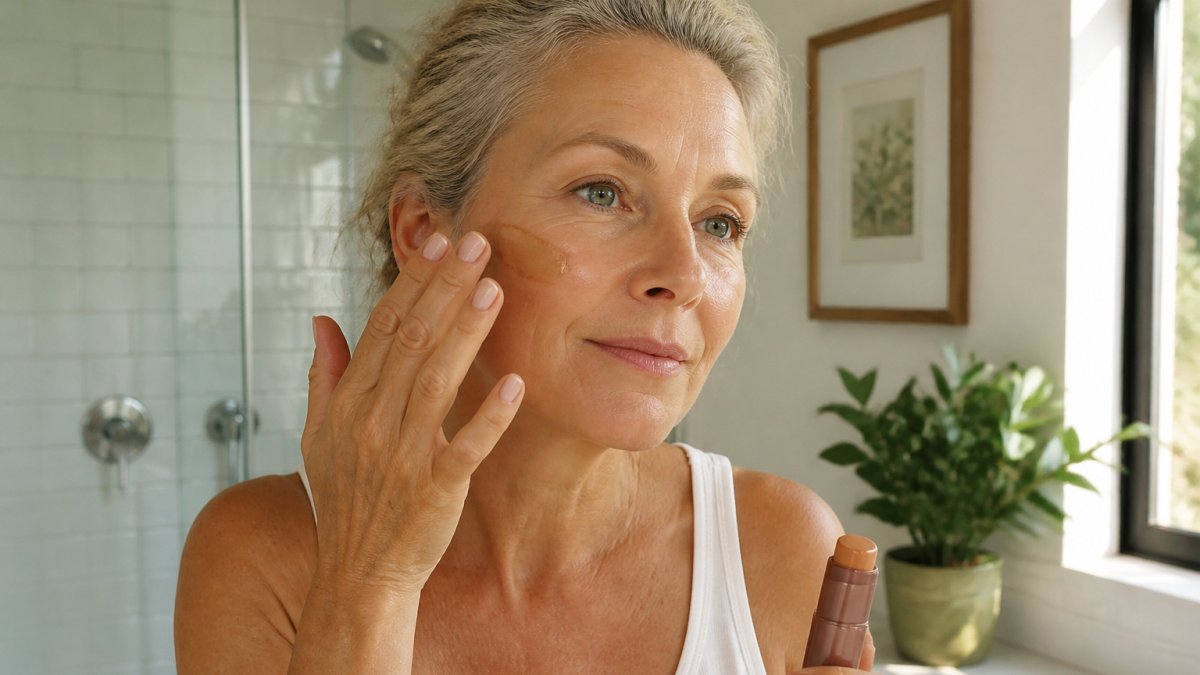
The best vegan makeup for mature skin is creamy, buildable, and applied sparingly. Powder-heavy formulas settle into lines; cream textures melt in and move with the face.
A few habits make the biggest difference:
- Hydrate before you apply anything
- Use less foundation than feels right
- Place blush higher on the cheek
- Swap setting powders for cream formulas where you can
Our Bronzer Stick ($39.00) is a creamy, vegan formula you swipe on and blend with your fingertips. It pairs with our Blush Stick and highlighter for a complete look. For more application habits, see how to apply makeup on mature skin, and if you're deciding between textures, cream or powder blush after 40 covers the trade-offs.

Common Myths About Vegan Makeup Performance
Vegan makeup can perform as well as conventional makeup when the formulation is sound. The myths persist because the underlying science is rarely spelled out. Here is what is actually happening in the jar.
Myth: vegan makeup does not last. Wear is governed by binders, film-formers, and pigment dispersion, none of which depend on an animal input. A cream bronzer stays put because its oil-and-wax phase is balanced to resist migration; a powder eyeshadow clings because the binder holds pigment to the lid. Where vegan formulas have historically failed is in texture matching, candelilla wax is more brittle than beeswax, so a poorly balanced formula can crack or flake. The fix is formulation, not animal ingredients. When you test a product, judge it on the same criteria as any other: does it crease, does it oxidise, does it fade by mid-afternoon.
Myth: natural means gentler. Plant-derived ingredients can irritate just as readily as synthetic ones, so patch-test anything new on your inner forearm before it goes near your face.
Myth: SPF in makeup is enough. It rarely is. Layering a dedicated sunscreen underneath is the reliable approach, and our guide to SPF in your makeup explains why.
Myth: vegan means the pigment is weaker. Pigment strength depends on the colourant's particle size and dispersion rather than on whether it is animal-derived, and many vegan formulas achieve strong, saturated colour.
Many mature-skin shoppers find cream formats more comfortable than powders, because creams tend to move with the skin rather than sitting on top of it.
Building Your Vegan Makeup Routine with Max and Louie
A vegan routine works best when the products are designed to sit next to each other. That's the principle behind everything we make: creamy formulas that blend together without fuss.
Start with a base, add warmth with the Bronzer Stick, then build colour. Keep it to a few products you'll actually use. Our makeup range is made for skin that's lived a little, and founder Nat offers a personal shade match if you're unsure which shade suits you. The Prepy Pouch ($42.00) keeps it all together and is made from vegan materials.

Frequently Asked Questions
Does vegan makeup perform as well as traditional makeup?
Yes, in most cases. Vegan makeup can use plant-based waxes, oils and synthetic alternatives in place of animal-derived ingredients. The key is the formulation, not the vegan label.
How can I tell if my makeup is truly vegan?
Check the full ingredient list for animal-derived ingredients such as carmine, beeswax, lanolin, collagen and shellac. Look for third-party certification logos, which require independent verification rather than a brand's own claim. Be aware that 'cruelty-free' only means no animal testing, not that the formula is vegan. A product can be cruelty-free and still contain beeswax. If a brand does not publish a full ingredient list, treat the vegan claim with caution.
Are vegan makeup products more expensive?
Not necessarily. Prices vary widely across the category. What drives cost is the formulation and the ingredients, not the vegan status alone. Our Bronzer Stick is $39.00.
Does using vegan makeup benefit skin health?
Vegan does not automatically mean gentle; ingredients of any origin can still cause reactions. Patch test new products and check the ingredient list if you have sensitive or mature skin.
The real challenge isn't finding vegan makeup. It's finding vegan makeup that suits mature skin and doesn't crease by midday. That's what we build at Max and Louie: creamy, skin-loving formulas, a personal shade match from Nat, and products designed to blend together. Get started with Max and Louie and build a routine that looks polished from morning to evening.
