

7 Signs Vegan Makeup Is Better for Your Skin
Last Updated: November 5, 2026
Quick Summary
Vegan makeup is not automatically better for every skin type, because it only tells you which animal-derived ingredients are absent, not how gentle a formula will be. A plant-derived oil can irritate sensitive skin just as readily as a synthetic ingredient can calm it. Match the formula to how your skin behaves rather than to the label alone.
- Vegan means no animal-derived ingredients; cruelty-free means no animal testing, and a product can be one without the other.
- Carmine is a naturally derived red pigment from crushed cochineal insects, so natural does not mean vegan.
- Patch test on the inner forearm for 24 to 48 hours and watch for redness, itching or swelling.
- For sensitive skin, choose fragrance-free and essential-oil-free formulas with a short ingredient list.
- For mature skin, check texture, hydration and finish, favouring serum or cream over powder.
Table of Contents
- What Vegan Makeup Actually Leaves Out
- Vegan vs Cruelty-Free Makeup: They Are Not the Same Claim
- Vegan Makeup Ingredients to Avoid if Your Skin Reacts
- Is Vegan Makeup Better for Sensitive Skin?
- Best Vegan Makeup for Mature Skin: What to Look For
- Match Your Shade Before You Switch Formulas
- Frequently Asked Questions
What Vegan Makeup Actually Leaves Out
Vegan makeup is a cosmetic product formulated without any animal-derived ingredients or animal by-products. That definition matters because the answer to whether vegan makeup is better for skin starts with what has been removed, not what has been added.
The honest answer is that vegan makeup is not automatically better for every skin type. A plant-derived oil can irritate sensitive skin just as readily as a synthetic ester can calm it. Vegan status tells you which ingredients are absent, not how gentle a formula will feel on your skin.
Below, we break down the ingredients that disappear, the ones that replace them, and how to judge a formula on its merits rather than its label.
Common Animal-Derived Ingredients in Conventional Makeup
Several standard cosmetic ingredients come from animals, and most shoppers never notice them on a label:
- Carmine - a red pigment derived from crushed cochineal insects, common in blushes and lip colours
- Beeswax - a binder and texturiser in lipsticks, balms and cream formulas
- Lanolin - a wax from sheep wool, used as an emollient in moisturising products
- Collagen - often sourced from bovine or marine tissue, added for plumping claims
- Gelatin and tallow - gelling and structuring agents in some creams
- Glycerin - frequently animal-derived unless the label specifies vegetable glycerin
A common mistake is assuming a product is vegan because it looks natural. Carmine, for instance, is a naturally derived pigment, yet it is animal-based. The ingredient list is the only reliable source.
Plant-Based and Synthetic Alternatives
Formulators replace those ingredients with plant oils, mineral pigments and synthetic waxes. Candelilla and carnauba wax stand in for beeswax. Mineral pigments replace carmine. Vegetable glycerin and squalane, often plant-derived, take over from animal emollients.
The practical upshot for your skin is that these swaps change texture and wear. Plant oils tend to feel richer and more emollient, which suits dry and mature skin. Synthetic waxes and dimethicone deliver smoother glide and longer wear. Neither category is inherently gentler, so match the formula to how your skin behaves rather than to the ethics alone.
Vegan vs Cruelty-Free Makeup: They Are Not the Same Claim
Vegan makeup means no animal-derived ingredients are in the formula. Cruelty-free makeup means no animal testing was conducted on the finished product or its ingredients.
This is where most buying guides get vague. The two claims answer different questions, and a label that says "cruelty-free" tells you nothing about whether carmine is in the blush.
When you verify a claim, look for third-party certification rather than a self-declared logo. In New Zealand, the Environmental Protection Authority regulates cosmetic products and their ingredients, and the Ministry for Primary Industries oversees labelling and product safety requirements. Neither certifies vegan status, so independent certification schemes carry the weight here.
Vegan Makeup Ingredients to Avoid if Your Skin Reacts
Plant-derived does not mean hypoallergenic. Some common irritants in cosmetics are botanical:
- Essential oils such as citrus, peppermint and lavender, frequent triggers of contact dermatitis
- Fragrance, whether natural or synthetic, is a leading cause of allergic reaction in cosmetics
- Coconut oil and its derivatives, which can clog pores in acne-prone skin
- Shea butter and rich plant butters, occlusive enough to aggravate congestion in oily skin
- Nickel traces in some mineral pigments, a problem for metal-sensitive skin
- Preservatives such as methylisothiazolinone, which cause reactions in a minority of users
Patch testing is a sensible way to check how your skin responds. Apply a small amount to the inner forearm, leave it for 24 to 48 hours, and watch for redness, itching or swelling. If you have a diagnosed allergy or a compromised skin barrier, ask a dermatologist before introducing new botanical actives.
Is Vegan Makeup Better for Sensitive Skin?
For sensitive skin, a vegan formula can suit you, but only when it is also fragrance-free, essential-oil-free and built on a short ingredient list.
Clean Skin Serum Foundation SPF 30+ →
The more useful question is what your skin type needs, because the answer changes by skin type:
- Sensitive or reactive skin: prioritise fragrance-free, essential-oil-free formulas with a short ingredient list. Look for barrier-supporting ingredients such as niacinamide, glycerin and squalane. Avoid products that lead with citrus, peppermint or lavender oils, which are frequent triggers of contact dermatitis.
- Acne-prone and congestion-prone skin: the vegan claim tells you nothing about comedogenicity. Coconut oil and its derivatives, rich plant butters and some botanical oils can clog pores. Look for non-comedogenic labelling and favour lighter emollients such as squalane or jojoba over shea or coconut.
- Dry and mature skin: plant oils and butters are an advantage here. Cream and serum textures with hyaluronic acid, glycerin or squalane near the top of the list support hydration better than powder-heavy formulas.
- Oily skin: synthetic waxes and silicones can deliver smoother glide and longer wear without the heaviness of rich plant butters. Do not assume vegan means lighter, check the emollient type.
- Eczema-prone skin: a compromised skin barrier can react to many ingredients beyond animal-derived ones. Patch test every new product and ask a dermatologist before introducing botanical actives.
Patch testing is the only reliable way to know how your skin will respond. Apply a small amount to the inner forearm, leave it for 24 to 48 hours, and watch for redness, itching or swelling.
Watch out: a product marketed as "natural and vegan" can contain allergens just like any other formula. Read the full ingredient list, not the front of the box, and treat "vegan" as one filter among several rather than a guarantee of gentleness.
The article matches vegan formulas to skin types like this.
| Skin type | What to prioritise | What to watch |
|---|---|---|
| Sensitive or reactive | Fragrance-free, essential-oil-free, short ingredient list | Citrus, peppermint or lavender oils |
| Acne-prone and congestion-prone | Non-comedogenic labelling, lighter emollients like squalane or jojoba | Coconut oil, rich plant butters, some botanical oils |
| Dry and mature | Plant oils and butters, hyaluronic acid, glycerin, squalane | Powder-heavy formulas |
| Oily | Synthetic waxes and silicones for smoother glide | Assuming vegan means lighter |
| Eczema-prone | Patch test every new product | Botanical actives without dermatologist advice |
Best Vegan Makeup for Mature Skin: What to Look For
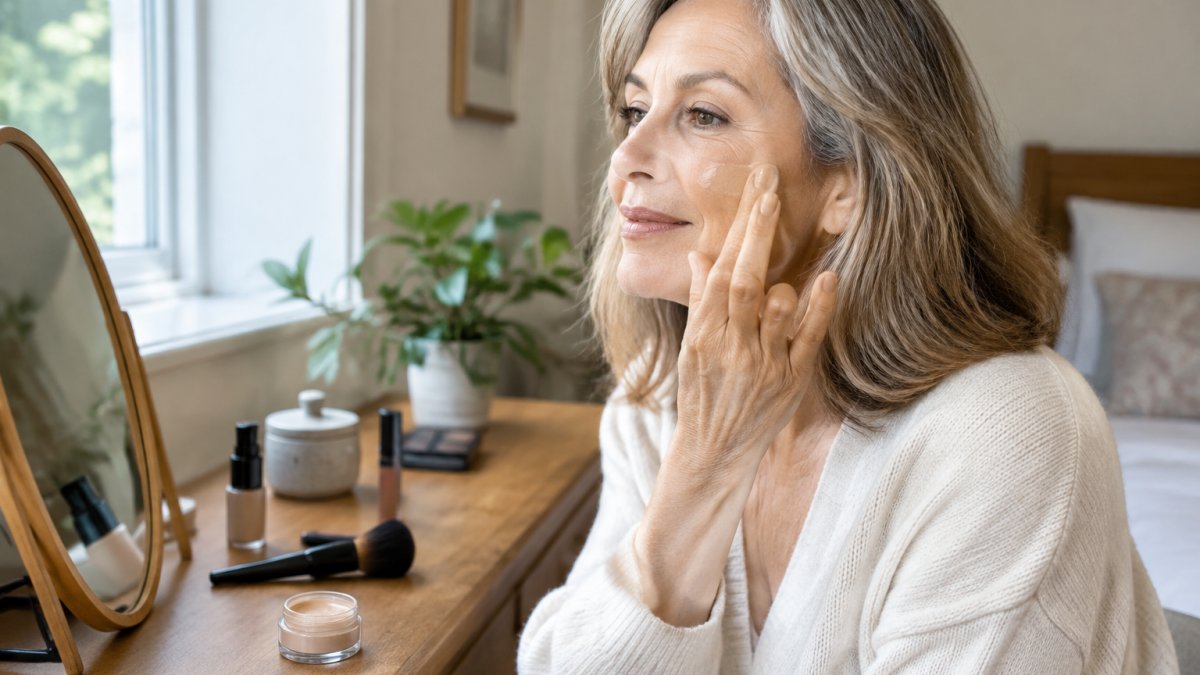
Mature skin often suits cream and serum textures, hydrating ingredients and dewy, buildable coverage. Powder-heavy formulas and matte finishes can emphasise texture.
Our Hydra Boost CC Cream pairs medium-to-full buildable coverage with hydrating ingredients, and it carries SPF50 protection for everyday wear. It is designed to melt into the skin for a fresh, radiant finish.

Three things to check before you buy:
- Texture - serum or cream over powder
- Hydration - hyaluronic acid, squalane or glycerin near the top of the list
- Finish - dewy or satin, not flat matte
Match Your Shade Before You Switch Formulas
Switching formulas can change how a shade reads on your skin, so it is worth matching before you buy.
The practical route is to match against your bare skin in natural daylight, not indoor lighting, and to test on the jawline. If you are ordering online, our shade match service can help you find your match from a natural-light selfie.
Once your base is sorted, complete the routine with a bronzer stick for warmth along the cheekbones and jawline, and a blush stick for cheeks and lips for a flush that doubles as a lip colour.


Frequently Asked Questions
Is vegan makeup better for your skin?
Not automatically. Vegan makeup only guarantees no animal-derived ingredients, not a gentler formula. A vegan product can still contain alcohol, fragrance or essential oils that sting sensitive skin, while a non-vegan formula built on mineral pigments may suit you perfectly. Judge each product on its full ingredient list and how your skin responds, rather than the vegan label alone. Patch test anything new on your jawline for two or three days before wearing it all over.
Can vegan makeup cause allergic reactions?
Yes. Plant-derived ingredients are still potential allergens. Essential oils, botanical extracts, coconut derivatives and some natural waxes trigger contact dermatitis in plenty of people, and a plant origin does not make a substance hypoallergenic. If your skin is reactive, patch test new vegan makeup on the inner forearm for 48 hours, keep a note of which botanicals caused a reaction, and favour shorter ingredient lists with fewer fragrance components.
What is the difference between vegan and cruelty-free makeup?
Vegan refers to ingredients: no beeswax, lanolin, carmine, collagen or other animal-derived components. Cruelty-free refers to testing: no animal testing at any stage of development. A product can be cruelty-free but contain beeswax, or vegan but made by a brand that still tests on animals elsewhere. Look for both claims stated clearly on the packaging or the brand's own site, and check whether the certification body is named rather than implied.
Is vegan makeup suitable for mature skin?
It can be, provided the formula is built for how mature skin behaves. Look for creamy textures with hydrating ingredients such as hyaluronic acid, squalane and niacinamide, and avoid heavy matte finishes that settle into fine lines. Buildable, lightweight coverage can feel more natural than heavy full coverage. A personal shade match is worth considering, as our founder Nat offers one to help complement your complexion.
The real test of any vegan makeup is not the label but how it wears by mid-afternoon. We built Max and Louie around creamy, skin-loving formulas that move with your face instead of settling into it, with a personal shade match from founder Nat so you order the right colour the first time. Browse the range and find your match.
